A Farris Story
Childhood Homes
My residential map from earliest memory through the year I moved out with Kati — a Tyrrell Ave apartment in Hayward, a hillside on Douglas a few years later, a basement in Oakland, a gated complex by the pool, a Hayward condo where my mom ran the place, a return to that same Oakland basement (this time with my own computer), and finally Tracy. Many roofs, a lot of moving, a few constants: a mom who kept us pointed in the right direction, two best friends, and the slow build of the kid who would eventually drive a blue Honda Civic to Colorado for a girl.
Tyrrell Ave
Address: Tyrrell Ave, Hayward, CA (specific apartment number not on record)
Before the hillside, before the saloon doors, there was a Hayward apartment on Tyrrell Ave — about a block from the Schafer Rd complex I'd end up at years later, though I had no way of knowing then that I'd circle back to that neighborhood.
I have only fragments from this place. I had to have been 1 to 3 years old, which is the edge of where memory becomes reliable.
What I do remember: it was a two-story apartment complex with one row of units on each side of a long shared driveway down the middle. We lived on the bottom floor. I'm fairly sure Jim wasn't living with us yet — this is before he was part of the daily picture.
The clearest fragment: a small round plastic kiddie pool set up in the middle of the cement driveway between the two rows of apartments. Other kids in it with me. Sun. Cement. The specific feel of warm water in a thin plastic shell. That's it. That's the whole movie.
It's the earliest place I lived that has any memory attached at all. Everything before it is a dark room.
The hillside
Address: 872 Douglas St, Hayward, CA 94544
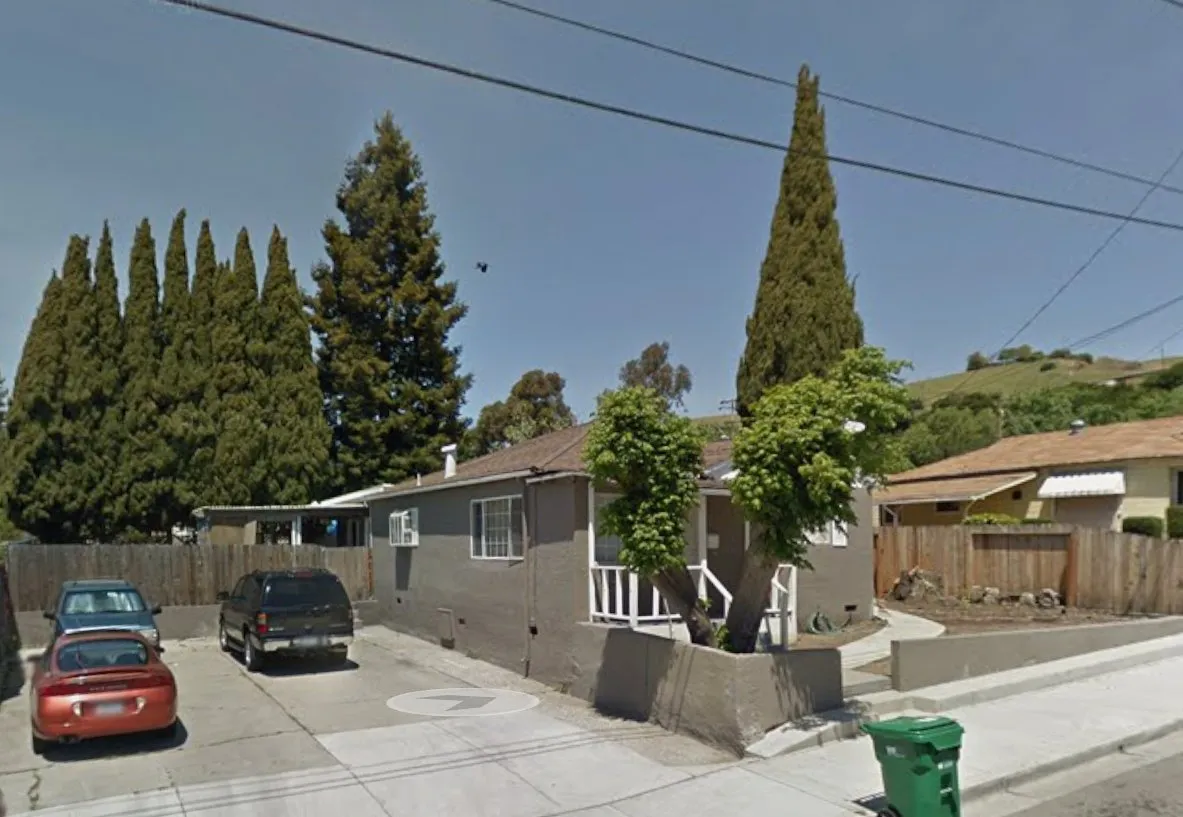
The first home I really remember sat on a Hayward hillside. We rented from a woman named Inez.
The layout still maps cleanly in my head. Front door opened into the front room with the couch. A second bedroom sat to the right as you walked in, bathroom somewhere nearby (the geometry blurs). Past the front room was the kitchen, and right off the kitchen was my bedroom — a room that had originally been planned as a dining nook, which meant it didn't have a proper door. It had saloon-style swinging doors. Two sets of them, one on each wall. The kind you'd push through into a Wild West bar. Three years old, and I had the coolest bedroom in the neighborhood.
Down a hallway off the kitchen, my parents' room. In that hallway, parked on a little rolling cart right outside my saloon doors, sat the Atari. I was the one who played it. Step down out of the kitchen and you were in the family room — TV, couch, pool table, sliding glass door to the backyard. The yard had a row of tight, tall pine-like trees with no low branches, planted close enough together to make a green wall. I checked Google Maps and they are still there!
This is where I ate Fruit Loops in the morning before school. This is where the first yellow school bus of my life pulled up and I cried — I was a mama's boy and not ashamed to say it then or now.
And this is where the Santa bicycle happened.
Mom looked up from whatever she was doing one evening and said, "Jimmy, I think I hear Santa." She sent me to the front door to scan the sky. Then — and the choreography of this still gets me — she walked me to the back door, told me to flip on the porch light, and said, "Now go look outside."
There was a covered shape on the patio.
I pulled the sheet off and there it was. My first bicycle. Whatever Mom didn't have, she made up for in moments like that.
The basement on 13th Ave
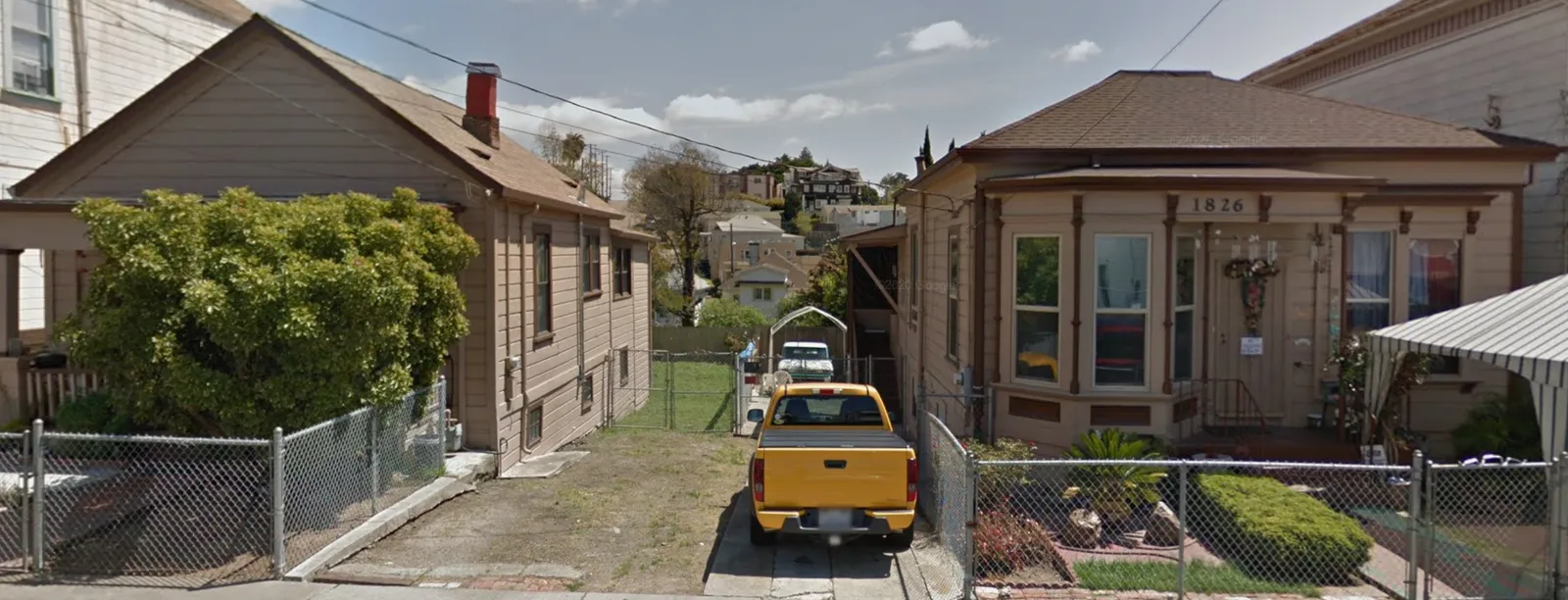
Address: 1826 13th Ave, Oakland, CA
We moved into Jim's sister Rita's house — Rita and her husband Jerry owned the place — and we lived in the basement.
It wasn't a dungeon. The basement was livable — carpet, a heater, real walls — though the bathroom down there never worked the entire time we were there. I had a 13-inch black-and-white TV with rabbit ears on top of my dresser. Our family dog was Pierre, a dachshund who took up about as much space as a loaf of bread. Rita and Jerry kept their own dogs — Sarge (a male German Shepherd) and April, his shepherd companion — out in the backyard.
Marcy, Jim's mom, also lived in the house. Puerto Rican, deeply set in her routine: front porch in the morning with a Budweiser and a cigarette, then back inside for soap operas — sometimes on the living room TV, sometimes in her bedroom. The house ran on her schedule whether you noticed or not.
The detail I carry hardest from the basement isn't a person, though. It's a moment in front of that little black-and-white TV. Some show was on about a kid who'd lost his dog and finally got him back. I was watching it alone. And I cried — really cried — at the reunion.
Mom came in at some point, saw the tears, and asked me what was wrong. I had to find the words for it as a little kid: the boy got his dog back. That was the whole sentence. She didn't laugh. I don't remember exactly what she said, but I remember being taken seriously — that the reason I was crying was a real reason. That mattered.
I still tear up at stuff like that. Reunions, comebacks, the moment somebody finally makes it. That's been wired into me since the basement.
Christmases at 1826
The other thing 1826 held — the warm thing — was Christmas.
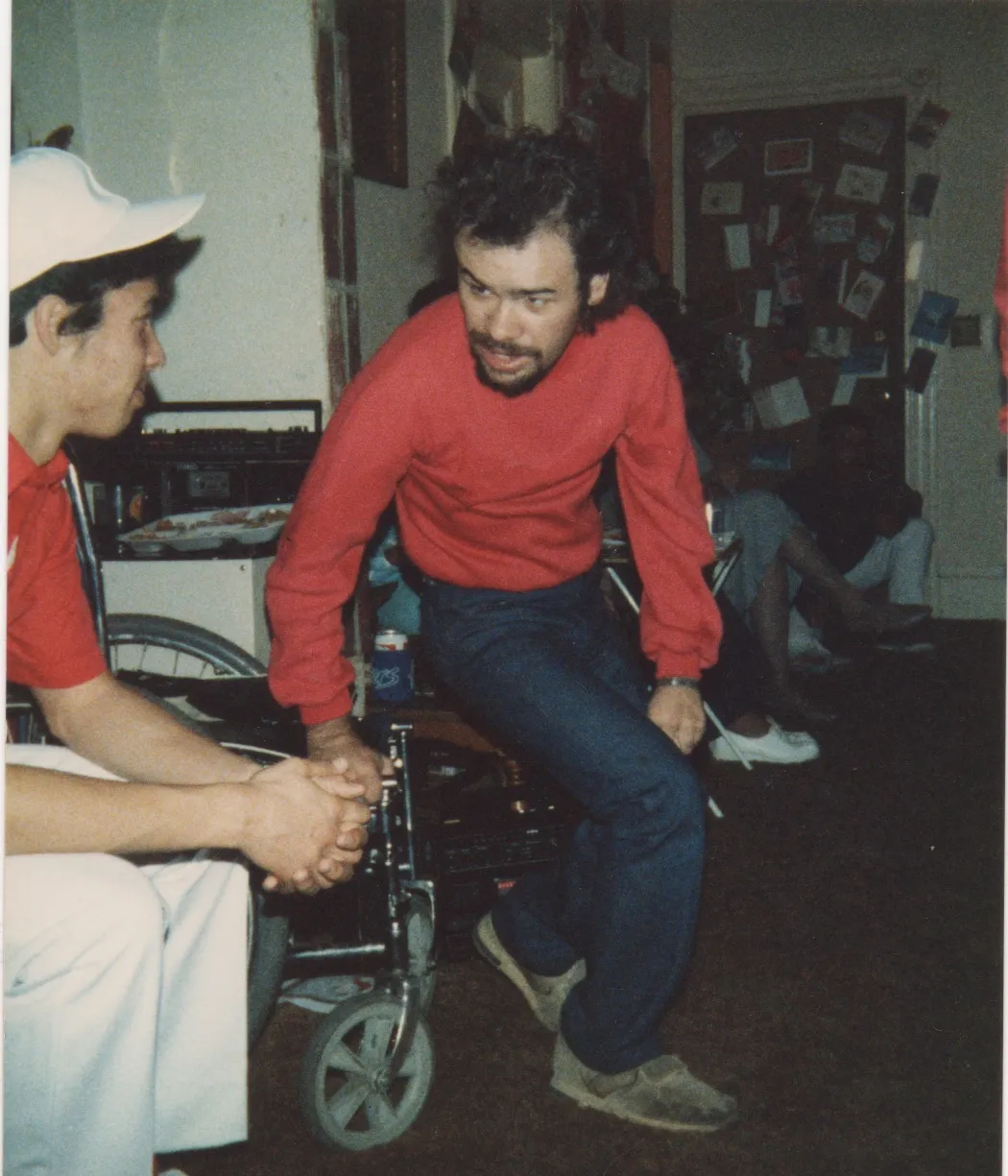
I grew up around a big Puerto Rican family on Jim's side, and 1826 was the gathering house for the holidays. Christmas Day, the place filled up with relatives I'd see once a year, voices sometimes in two languages talking over each other in the kitchen, and the smell of food coming from every direction.
Rita's living room had this bay-window-style nook at the front of the house — floor-to-ceiling windows that bumped out from the wall — and that's where the Christmas tree went, every year. Around the tree, a small mountain of presents for the whole family that would be coming through.
But the tree itself wasn't the showstopper. Rita's collection was. She had Santa dolls standing watch. Porcelain dolls dressed in Christmas red, faces painted to look almost real. Tinsel on every surface that could hold tinsel. Candles, ornaments, ribbons, garlands. She loved Christmas, and she loved showing she loved Christmas, and that bay-window front room was her stage for it.
It's one of the warmest sets of memories I have from the basement years.
The breakdance circle
The other thing those Christmases had — and you have to remember this is the mid-to-late '80s — was breakdancing.
Not professional, nobody was a pro. Family breakdancing. Old and young, cousins and aunts and uncles and parents, all of us. Somebody would put on the hip-hop tape, and a circle would form in the living room. Someone would lay a sheet of wrapping paper from the morning's gifts down on the carpet in the middle of the circle — because trying to spin on your hands or head directly on the carpet wasn't a smart idea, and the slick paper made you faster anyway. Then, one by one, people stepped into the middle to do their move while the circle cheered, clapped, laughed, called them out.
I was not anything special. But I have a clear-as-day memory of being 6 years old, dropping into the middle of the circle, planting one knee on a torn-off piece of wrapping paper, and spinning. Silly. Clumsy. Entirely without judgment from a single person standing around me.
Six-year-old me thought I was breaking concrete in the Bronx.
Jim, the family entertainer
Jim always had to perform. He was the entertainment of any gathering my whole childhood. He'd stand on his hands and walk around the room — not for a few seconds, but a real distance, ducking under doorways. He had whole bits. He was the family flirt, in that specific 80s-Puerto-Rican-uncle way — every woman in the room got the playful-uncle treatment, the over-the-top compliments, the goofy gestures. People expected it. People laughed. That was Jim at a party.
The first death I remember
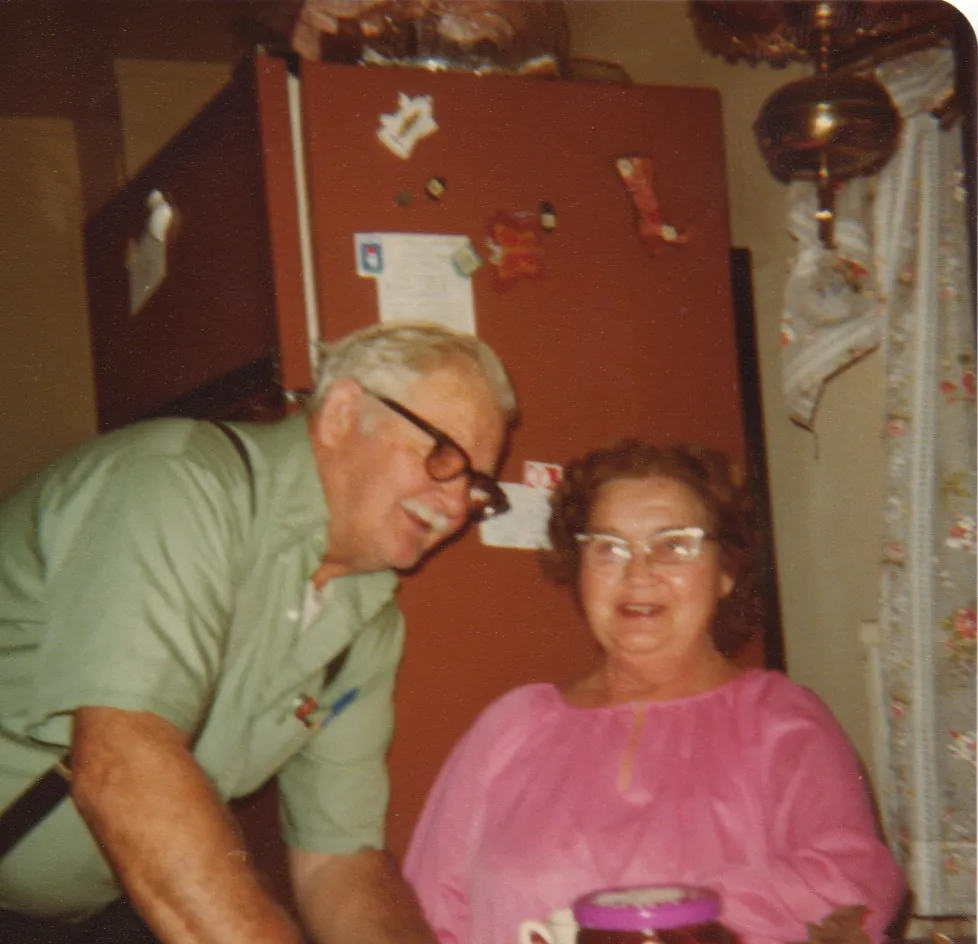
There's another moment from the basement that I carry. 1986, so I was six. I was sitting on a chair in my parents' bedroom down there — the room that, ten years later, would become my living room when I came back as a teen — and Mom told me my Great Grandma Ursella Waits had passed away.
I didn't know how to take it. I knew the words. I'd just never had to put them on someone before. I remember asking questions, the kind of questions a six-year-old asks when he's trying to fit a brand-new shape into his head. Where is she now? What does that mean? Are we going to see her?
It's the first death in the family I remember as a kid. There would be others later, hard ones, but Great Grandma Ursella was the first time the world quietly told me there was a category I hadn't been ready to learn about.
Jim and Mom both grew up in Oakland — their families had known each other since Mom was a baby. Jerry worked for PG&E for decades and is still around. Rita and Marcy are both gone now.
Del Rey Elementary, K–7
While we lived on 13th Ave, I went to school in San Lorenzo. Mom used my great-grandparents' San Lorenzo address to enroll me at Del Rey Elementary — better schools than the ones zoned to where we actually lived. K through 7th grade.
I met Carl in 2nd grade. We clicked immediately. Then in 3rd grade his family moved away, and he disappeared from my map for years. (We'd find each other again in 8th grade at Arroyo High, and stay friends for the rest of my life. But that's later.)
The hard part of Del Rey came in 5th through 7th grade, courtesy of one specific kid. He had a thing about coming up from behind me at recess, knocking me to the ground, calling me names, and then walking off. Repeat the next day. He poisoned what should have been some of the easiest years of childhood. I started telling Mom I didn't feel good in the mornings. Some days she let me stay home; some days she didn't. One morning I refused to get out of the car, and a school staff member had to come outside and coax me through the front doors.
I don't think the bully ever realized what he did. Most of them don't.
There were also the two short-lived 6th-grade "relationships," if you can call them that.
The first: a girl all the boys had been after did one of those grade-school lottery picks and chose me. We "lasted" about four hours — she wanted to hold hands and hug, and I was too shy to do either.
The second I can replay frame by frame, even now. We were lining up inside the classroom to go to lunch when her friend snuck out of line, came over to me, and told me she liked me. Wanted to be with me. I wasn't interested. The friend pushed. I held the no for a minute, then more pressure, and finally — the way an outnumbered 11-year-old folds — I said okay.
After lunch, during free time, we met up to actually talk.
The frame is still sharp: we were out on the blacktop, standing by the metal rails that ran along the edge. I was facing the bathrooms that jutted out into the yard; she was on the rail side facing me. Behind me, in the distance, was the PE field where we ran the mile. I don't remember the exact words I said. I remember I told her I didn't want to be with her. I remember she cried right there at the rails. I remember walking away feeling like I'd done something wrong by being honest, and not knowing how to do honesty and kindness at the same time yet.
We're still distantly in touch on Facebook. I think we both ended up okay.
I don't count either of them as a relationship. I had to wait for the AOL chat in Capitola for that.
Schafer Rd
Address: 750 Schafer Rd, Unit 12A, Hayward, CA 94544
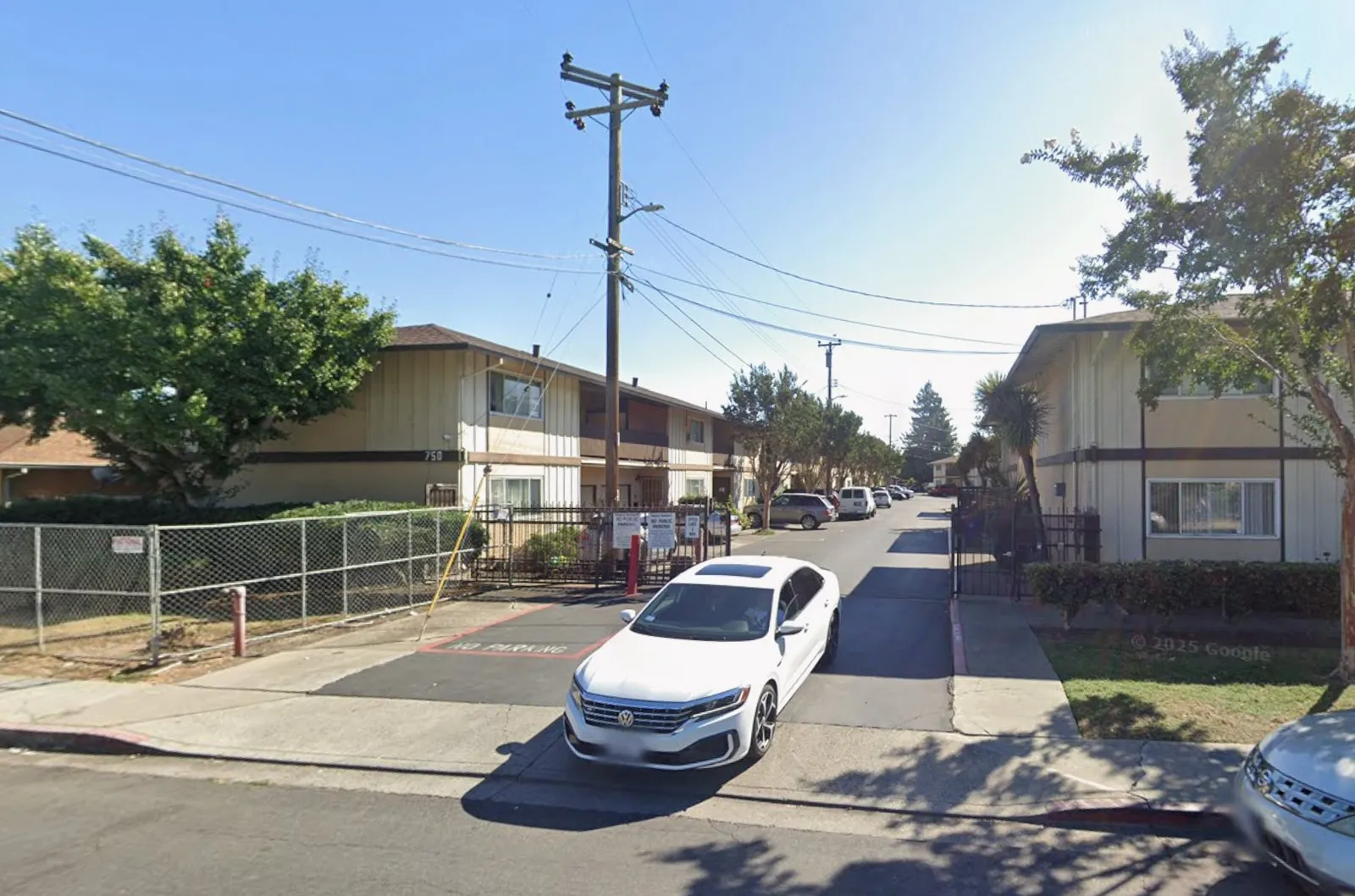
Back to Hayward. Different chapter, different feel.
We moved into a gated apartment complex on Schafer Rd, and we ended up in the house at the very back — the one right next to the pool. Technically this should have been the manager's house for the apartment, but somehow my mom convinced them to let her live there. The only place I lived growing up that had a pool. I learned to swim there.
The pool produced one of my favorite Jim memories. He went to fly a kite from the pool deck one afternoon, but instead of regular string he used fishing line. Lighter. Stronger. So he kept letting it out, and out, and out — until the kite was a dot in the sky. A literal speck. And then the police rolled up to the gate. Apparently the kite had climbed high enough to interfere with air traffic. They asked Jim, very politely, to bring it down. He did.
The Harder Rd routine
Jim picked me up from school just about every day during the Schafer Rd years — which meant his commute was Oakland → San Lorenzo → Hayward, the long way around the East Bay just to get me home. I remember the route because we always passed the house my uncle Danny Waits and Sher lived in, on Harder Rd — the cross street of Schafer. The Kelemen side of my future was years away yet, but the Waits side was already shaping the geography of my afternoons.
There was a small ritual at that turn. Around the Harder Rd corner I'd ask him, "Do you have to use the restroom?" I wasn't asking out of concern — I asked every day, because that's what he did every day when we got home. Every afternoon, the moment we walked in the door, Jim went straight for a bathroom. We had two: the main one, and a second toilet that lived in the laundry room, of all places, alongside the washer and dryer. The laundry-room one had a door that locked from the inside. That was the one he chose. It was located in the garage.
It took me longer than it should have to figure out that restroom wasn't exactly what he meant. He was going in there to slip into a different version of himself — the one I'd see come out a few minutes later. Ramped up. Never angry, always happy. A little louder. A little brighter. A different person.
And every single time he came out of that bathroom, I knew the second half of the routine: I could ask, "Can I go to Steven's?" — and he would always, always say yes. Because he wanted to be alone in the version of himself he'd just become.
I knew the game. He knew the game. We never named it. I got my friend time. He got his quiet. The afternoon continued.
Steven
The other gift of Schafer Rd was Steven. He lived in the same complex with his mom and stepfather, and he became the best friend I needed after Carl moved away. Born January 16, 1980 — a few months ahead of me (May 10, 1980) and a month ahead of Carl (Feb 14, 1980). The three of us would eventually all overlap, but that wouldn't happen for years.
Steven's biological dad lived about a mile away in a Hayward house he owned with his wife. Steven split his time — mostly at his mom's, every other weekend at his dad's. I stayed the night at both places, often. He had a younger sister, maybe six at the height of all this, and sometimes I'd come over just to keep her entertained while Steven was off doing whatever.
Sleepovers were a regular thing — and they came with one detail I'm grateful I learned young. At his mom's place we had a system: single bed, the two of us at opposite ends, feet pointing toward each other. It worked.
Steven sometimes wet the bed. The first time I woke up in the middle of the night to change sheets I was confused — I was a kid, I thought potty-training was something you finished and then you were done with. It took me a minute to understand that this wasn't about training. It was something he didn't have control over.
That ended up being one of those small moments that taught me something I've tried to carry forward my whole life: don't judge people for the things they can't help. Steven outgrew it eventually. The friendship outlasted the sheets.
We played Teenage Mutant Ninja Turtles, G.I. Joe, every action figure we could get our hands on. We both had the original Nintendo when it dropped, so we'd cycle between his apartment and mine, taking turns on Super Mario Bros. and the rest. He was my real-world escape valve from the Del Rey bullying — proof that there were friendships out there that didn't come with bruises.
The one Steven memory I cringe at: a girl was visiting family at the complex, Steven turned on the charm, and somehow the night ended with the two of them making out on my bed in the middle of the night. I was furious. Ten-year-old jealous, ten-year-old proud, and possibly slightly out of my depth. I yelled them both out of the house, not caring whether I woke up my parents. Real friendship survives that kind of thing. We did.
There were a couple of other complex kids around the edges — Robbie, who was younger, and his stepbrother Dustin, also younger — but they were peripheral. Schafer Rd, in my memory, is mostly Steven.
Trips with Steven's family
Steven's mom and stepfather (at the time) pulled me into a few of their family trips that got me seeing parts of California I wouldn't have seen otherwise. We did lighthouse day trips up the California coast — pull off the highway, walk out to whatever windswept point the lighthouse was sitting on, take it in, drive on to the next one. Lighthouse-hopping. I'd never done anything like it.
The one I remember most was a visit to family they had somewhere in the California Central Valley — the big-acre kind of valley family, the kind with bow-and-arrow setups in the yard and dirt bikes in the shed. Steven and I both walked away from that weekend with stories.
My story was the bow. I had no idea what I was doing. I drew the bowstring back with my left index finger curled around the arrow shaft to steady it — and then I never moved it. When I released, the arrow tore past my fingertip and drove fiberglass and wood splinters into the joint of that finger. Bad enough that I needed outpatient surgery later to get the rest of them out. The thing I remember most clearly about the surgery isn't the splinters or the procedure itself — it's the needle they used to numb the finger beforehand. It felt like my finger was about to explode. The numb part came later. The needle still wins the memory.
Steven's story was the dirt bike. He'd watched me do a slow lap around the perimeter of the field — I'd never figured out how to switch gears, so I was crawling along in first the whole time. He hopped on after me, rotated the throttle back without realizing how much torque was about to come on at once, and the bike took off with him along for the ride. He made it about as far as the fence.
He walked away with bruises. The fence took the worst of it.
We were not bow-and-arrow people. We were not dirt-bike people. But for one weekend in the valley, we tried.
The earthquake
October 17, 1989.
I was alone in my bedroom on the NES, playing Bases Loaded. Jim was somewhere in the house with one of my step-brothers. Mom was at work at Bud Plant.
Then the floor turned into water.
I won't relitigate the whole thing here — that has its own page. The short version: I needed therapy after. I slept in my parents' room for months. And to this day, when something in the house shakes, I am a 9-year-old in his bedroom for half a second before my adult brain catches up. The earthquake is one of the load-bearing pieces of who I am, and not in a way I would have chosen.
Bud Plant
Speaking of Mom — she worked at Bud Plant Comic Distributors through this era, eventually rising to assistant manager before the business was rebranded Diamond Comics. Bud Plant was a regional wholesale distributor: the place comic shops got their inventory.
For a kid, that warehouse was a kingdom. Mom let me do simple little tasks and paid me in comic books and baseball cards, which is where my entire childhood collection came from. In the back of the warehouse, she let me build forts out of stacked printer-paper boxes — a literal mountain of cardboard, hollowed out into rooms. And I rode the pallet jacks like scooters down the aisles when nobody was looking. Different times. Nobody filed an OSHA complaint. I survived.
Royal Ave
Addresses: 21070 Royal Ave (first), then 21096 Royal Ave once Mom managed the complex — both Hayward, CA 94541
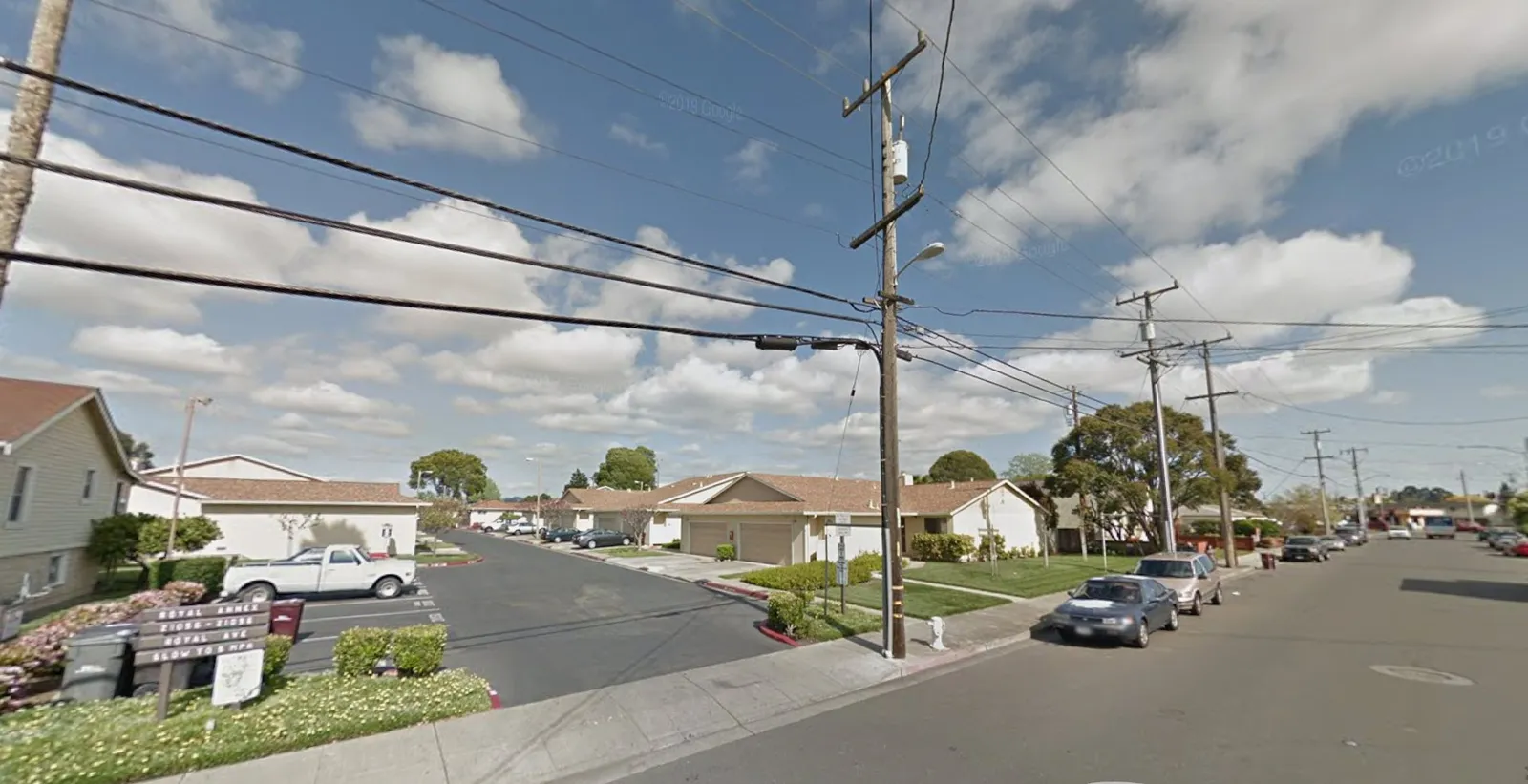
End of 7th grade, beginning of 8th, we moved into a one-story condo complex on Royal Ave. Eventually Mom became the manager of the complex, which earned us the move to the front unit — 21096, the unit that came with the keys to the place. She was always finding ways to do that: take whatever the rented life offered and make it a little better.
This is where my world reconnected.
Carl re-entered the story in 8th grade — we crossed paths again at Arroyo High, and from then on he picked me up at Royal Ave most mornings to drive together to school. His mom lived in Hayward; his dad lived behind the high school. And then mid-high-school, Steven transferred from San Lorenzo High to Arroyo. So for the first time, my two best friends — the one from 2nd grade and the one from Schafer Rd — were in the same hallways at the same time. They'd never met before that.
That doesn't sound like a big deal until you live it. For a kid whose life had been stitched together across four cities and a half-dozen houses, it was like watching two parallel timelines meet.
Prank calls and a corded phone
Royal Ave 21070 is also where, in roughly 1994 — I was 14, peak goofball — I discovered the prank-call era.
There was no caller ID yet. There was just our beige corded phone, the local White Pages thick as a brick, and an entire afternoon stretching out in front of me. I'd dial random numbers and run whatever bit my 14-year-old brain had cooked up that week. The harmless ones — "Is your refrigerator running?"-tier — half the time ended with the other person hanging up after three words, and half the time ended with me losing my nerve mid-sentence and hanging up first.
But there's one of those calls I'm going to admit to here, because the wiki only works if it's honest, and I want my future self — and Mia, if she ever reads this — to see the kid I was and the man who outgrew him.
I had a pump-action BB rifle. Pellet gun, the kind where each pump of the lever loads more air pressure into the barrel. The more pumps, the louder the shot. I figured out somewhere around twenty pumps it didn't sound like a toy anymore — it sounded like a real gun.
So one afternoon, dialing random numbers, I called a woman, and instead of running a bit I pretended I was in trouble. Acted scared. Said someone was threatening me. Then I fired the rifle into the air — and let her hear it. She panicked on the line. I yelled "oh my God!" and hung up.
Fourteen-year-old me thought it was the funniest thing in the world.
The man writing this is horrified.
I don't know who that woman was. I don't know what her day looked like before that call or after it. I think about it sometimes — what it would feel like to be on the other end of a stranger pretending to be shot in your ear, and then to never know what happened next. It's not a thing I would do today, and not a thing I'd ever defend. It's in here because it's part of who I was. The kid who'd spent years being bullied at Del Rey also spent some of his teenage years being unkind in his own ways. Both can be true.
I never made a call like that again. Some lessons you only need once.
The garage and the homemade speakers
That same condo is where I started tinkering.
I'd take apart anything I could get my hands on — and home audio speakers were my favorite. The garage was my workshop, and I'd be out there on weekends pulling drivers and crossovers out of cabinets, trying to figure out how the wiring went together, what made a tweeter different from a woofer, why the magnets were so heavy.
The grail project was hooking my Walkman up to a real speaker. Small batteries, line-level audio out of a portable cassette player, into something that could actually push air. Eventually I figured it out, soldered up a setup that worked, and brought small homemade speakers to school in the very beginning of high school — playing FM radio off a Walkman, through speakers I'd built myself, in the hallway. Wasn't loud, wasn't a party, but it was mine. First time I remember feeling that builder's pride that's followed me into web development, into the Etsy magnet shop, into ryderush. The garage at 21070 Royal is where it started.
The garage, the stepbrother, and a basketball hoop
A different garage memory, harder edge.
I was 14 or 15. One of my stepbrothers was around at the time and brought a girl over. They wanted privacy, specifically to use the garage to "do stuff" — and I was the kid currently using the garage, because that's where my basketball hoop lived. I had one of those wheel-out hoops I could roll into the driveway and shoot baskets in front of the condo.
I told them no. They tried to talk me into it. I said no again, more firmly, and after enough back-and-forth they left.
Looking back, I think the bullying years had wired something into me that I didn't yet have a name for: a low tolerance for being walked over. I'd spent 5th through 7th grade letting the same kid knock me down at recess, and somewhere in there I'd quietly decided I was done being the easier option. That afternoon at the garage was a small, specific no — the first one I really remember planting my feet on.
I'm leaving the names out. The point isn't who; the point is the no.
The afternoon my bike went away
One last memory from that house.
I was riding my bike around the complex one afternoon — the kind of aimless, hours-long looping that summer afternoons used to allow. I rode up to the front of the complex and noticed a guy I didn't recognize watching me a little too closely. The kind of look you feel before you decide whether to feel it.
I rode straight back to our condo. Wheeled the bike into the garage through the manual roll-up door, walked into the condo from the inside garage door, and didn't bother to close the garage behind me. Manual garages didn't auto-close. I didn't think about it.
I was inside maybe a minute. Maybe less. When I came back out — the bike was gone.
That was a long ride home in my head, and I never got the bike back. Some lessons you only need once. (That's two from this house. The pump rifle and the open garage. Apparently I needed both.)
Uncle Danny, in the front unit
This one I had genuinely blocked out of my own memory, and I'm only writing it down here because my mom recently reminded me of it. When she did, it came back.
This was after we'd moved into the front unit at 21096 — the manager unit. My Uncle Danny showed up one day belligerently drunk — or maybe on something else; I don't think we ever fully knew. I might have been the one who opened the door for him. I don't remember.
For whatever reason — to this day I don't know what set him off — he had it out for me. I was the target. He never put a hand on me, but he **threatened me, and he chased me around the house threatening to kill me — his words.
My mom was there. She told him plainly to leave me alone or she would do something to him.** Not a happy scene.
Eventually she told me to get out. Out the back door, through the backyard, through the side gate. Go around the corner to the head managers.
The head managers of our complex also managed other condos in the area, and lived a block over. I knew exactly where their place was, because every month my mom had to bring them the rent money from all the tenants in our complex. They were nice people.
A small piece of context I find quietly fitting now: those same head managers, before they moved around the corner from Royal Ave, had managed and lived in the Schafer Rd apartments — the place I'd lived during the Hayward-mid-childhood chapter earlier on this page. We'd been their tenants twice, in two different complexes, in two different chapters of my life.
Back at our condo, my mom got on the phone to Jim at work and told him he needed to come home right away, or she was going to do something drastic to Danny.
A scary afternoon. Just another incident I was reminded of as I got older — the kind that quietly stacks up under the surface of a kid's life.
My mom ended up taking him to the airport where she shipped him off to Arizona.
The Oakland basement, take two
Addresses: back to 1826 13th Ave (basement, this time mine alone), with my parents next door at 1836 13th Ave
Late high school, we landed back at Rita's on 13th Ave — but the configuration was different this time. The basement was mine alone. My parents moved next door to 1836, a small house Rita also owned, so I had two rooms below ground all to myself.
Walk through the outer basement door and you stepped into an entry. To the right, the under-the-house space where Jerry kept his tools. To the left, a short hallway with a step down into two doors. The door straight ahead was the bathroom — still not working, all those years later. A quick right brought you to the door to my bedroom. Just inside, on the right wall, a doorway with a little step up into the larger room.
I made the larger room my living room. Couch against the left-hand wall, a low window behind it that never caught any sunlight because the house next door blocked the angle. Across from the couch: a TV. To the left of the TV, kitty-corner to the wall, a desk. And on that desk: a computer.
That computer is the one. The one I logged onto AOL with after the first chat at Aunt Sher's in Capitola. The one I searched Dogstar98 from. The one where the pinging bloop of an instant message arriving started to mean something specific. The one that hosted the months of conversations that built the Seabright Beach meeting in June 1998. This is the basement I was living in when I met Kati. (See how-we-met and early-dating.)
Rita the second time around
The teen-return version of Rita was different from the one I'd grown up around at Christmas. Or maybe it was the same Rita and I was just old enough now to be on the receiving end of the part of her I'd previously only watched her use on other teenagers in the family. She was strict — particularly with teenage cousins and step-cousins moving through the house. I'd seen it before; this time it was pointed at me.
The day that stands out: she told me to weed-eat the backyard next door at 1836, where my parents were living. I hesitated, but I said yes — I was a teenager renting basement space rent-free, the work was reasonable, and I wasn't going to argue.
The work, on the other hand, did argue. Burrs sticking to my clothes. Foxtails working their way down into my socks. Hot summer weather. Allergies in full bloom, my eyes streaming the whole time. I'd been out there a while when Mom came over and told me to stop. I did — and that started one of those arguments between her and Rita.
It wasn't the first one. It wouldn't be the last.
Moving to 1836
Then, after Kati and I were officially together, I moved up out of the basement and into the house next door at 1836, with my parents.
A full circle from the saloon doors at 872 Douglas. Twelve years and four moves later, and I was back to a curtained dining-room bedroom.
It's the house where Kati and I celebrated my birthday and our first Christmas together as a couple. So even with no door and a thin curtain between me and a one-bedroom house's living room, that little dining-room bedroom holds a piece of us in it.
It didn't last. A hard chapter at home meant Rita decided she couldn't keep us in the house, and she made the call she felt she had to make. The argument that ended our time on 13th Ave was the harshest of all of them. We had to find somewhere else to land.
That's how Tracy happened.
A coda about Rita
I didn't see Rita again for a long time after that. Decades, in fact — probably not since around the time I met Kati and we eventually moved out of Oakland for good.
She passed away in 2021, under hospice, in that same bay-window front room where she'd put up Christmas trees every year of my childhood. Before she went, I got to visit her one more time. It had been so long that the visit was its own kind of strange — a teenager's last memory of her colliding with a 40-something man's first new memory of her in twenty years — but I'm grateful I got that. The hard chapters never erased the Christmas ones. Both are true.
Tracy
Addresses: 234 E 10th St #3 (first), then 1540 Lynch Dr — both Tracy, CA 95376
We moved to Tracy, CA. Two homes, in order:
10th Street first. Within walking distance of Grandma Lorraine — my paternal grandmother, my biological father's mom, on the other side of my family from everyone you've met so far. The 10th Street house is where I was living when I drove Kati's blue Honda Civic packed with everything she owned across four states — California, Nevada, Utah, Wyoming — to Aurora, Colorado for vet-tech school. About a week later I flew home. (That's a whole story of its own — see kati and the Colorado chapter for the long version.)
Lynch Drive next, the rental we stayed in until I moved out for good. I lived here until Kati and I got our first place together in Sunnyvale in the early 2000s. After I moved out, Mom and Jim eventually moved to Sonora, where they still are.
What it adds up to
Eight roofs by the time I left for good — counting both stints at 1826, the one-bedroom at 1836, and the two Tracy houses. Plus the hillside, Schafer Rd, and Royal Ave (twice, once Mom managed the place).
I didn't grow up with stability in the way most of my classmates did. We rented every roof I ever slept under as a kid — and a couple of them, more than once. But Mom kept us pointed in the right direction with whatever she had: pulling a Santa bicycle out from under a sheet, using a great-grandparents' address to get me into a better school, working her way up at a comic warehouse so I could pay my way in baseball cards, eventually managing a condo complex from the front unit.
When I think about why I told Kati, early in our dating, that I felt blessed to be becoming a part of her family — it's because by then I'd already been the kid in the hillside saloon-doors bedroom, the kid in the Oakland basement, the kid by the pool who learned to swim, the kid prank-calling strangers from a beige condo phone, the kid who slept in his parents' room for months after an earthquake, the kid in a basement listening for an AOL bloop, the kid in a curtained dining room celebrating his first Christmas with a girl from Los Altos, and the kid who drove a blue Civic to Colorado for the right girl.
I knew exactly what I was looking at when I sat down at that Kelemen lunch.